-01%201.svg)
Key takeaways
- A client communication cadence is a structured, recurring schedule of touchpoints (weekly updates, monthly reviews, quarterly deep dives, and escalation protocols) that replaces reactive firefighting with proactive partnership and measurably improves retention.
- Firms running structured cadences report 40 percent better engagement and 50 percent faster responses, translating directly into fewer crises, more referrals, and smoother peak seasons.
- Pre reads, clear agendas, and role clarity (partner, manager, analyst) make meetings shorter, sharper, and more valuable while cutting prep time from hours to minutes.
- NPS surveys tied to a 48 hour acknowledgement, seven day action plan, and 30 day follow up surface issues before they escalate and give detractors a reason to stay.
- In India, aligning cadence to GST filing dates (reviews on the 7th, GSTR 1 on the 8th, GSTR 3B on the 10th) eliminates most last minute scrambles.
- When pre read generation and dashboard assembly eat into analyst time, automated MIS reporting pulls Tally data into client ready summaries so your team focuses on insight, not data entry.
Client Communication Cadence for CA Firms: What's New in 2026
Two regulatory shifts since April 2025 have changed how CA firms plan their communication cadence with clients.
First, the CBIC's phased expansion of e-invoicing now covers businesses with aggregate turnover above ₹5 crore. This pulls a larger pool of SME clients into mandatory real time reporting, which means your monthly review pre reads now need to include e-invoice generation status, IRN validation, and any auto-populated GSTR 1 mismatches. Firms that haven't added these checkpoints are seeing ITC claims blocked for their clients at the portal level.
Second, the GST Council's push toward quarterly GSTR 1 filing for small taxpayers under the QRMP scheme has created a split cadence challenge. Some clients file monthly, others quarterly. If your cadence calendar treats everyone the same, you either over communicate with QRMP clients or under communicate with monthly filers. The fix is to tag each client's filing frequency in your tracker and adjust review timing accordingly.
The operational impact is real. Firms that haven't updated their escalation SLAs for e-invoice errors (which can block sales within 24 hours) are fielding tier two and tier three calls that should have been prevented by a five minute check on the 5th. Late adoption of these workflow changes risks penalties under GST portal rule 48(4), including ₹10,000 per instance for non-generation of e-invoices.
What to do now:
- Audit your client list by turnover threshold and filing frequency. Tag each as monthly or QRMP.
- Add e-invoice status (IRN validation, auto-populated GSTR 1 match) to every pre read starting this month.
- Update escalation SLAs: e-invoice generation failures should be treated as tier two with a 12 hour response window.
Tools that sync Tally data nightly and flag e-invoice mismatches automatically, such as GST reconciliation platforms, turn these checks from manual chores into background alerts your team reviews in minutes.
Introduction
It is the 9th of the month, GSTR deadlines loom tomorrow, and three clients call about missing invoices. Meanwhile, your largest client emails to "discuss the arrangement." The cure is a disciplined, predictable rhythm of touchpoints, a client communication cadence that transforms chaos into calm.
Firms running structured cadences report 40 percent better engagement and 50 percent faster responses, leading to fewer crises, more referrals, and less stress during peak season.
This playbook gives you templates for monthly reviews and quarterly deep dives, NPS surveys, escalation matrices, and the exact messages to send when things go wrong. By the end, communication turns from a weakness into your edge.
Bottom line, cadence builds trust, trust retains clients.
What Does Effective Client Communication Cadence Look Like
A solid client communication framework is not about more meetings. It is about the right meetings, at the right time, with the right preparation.
Think in three operating modes. During onboarding, you are high touch with weekly check ins. In steady state, you shift to monthly and quarterly rhythms. During peak periods like March close or GST quarter ends, daily updates may be necessary.
- Transactional Updates, weekly or as needed via email and WhatsApp, for reminders, document requests, and filing confirmations.
- Monthly Reviews, 30 minutes via video or in person, to review exceptions, compliance status, and quick wins.
- Quarterly Deep Dives, 60 to 90 minutes, to analyze trends, plan taxes, and explore upgrades.
- Escalations, immediate via phone, to resolve breakdowns and protect trust.
Roles matter. Partners own strategy and relationships. Account managers coordinate day to day work and meetings. Analysts assemble pre reads and flag exceptions.
Align cadence to real workflows. Know when bank statements arrive, watch Tally reconciliation cycles, and map GST due dates on the 8th and 10th. For clients on Zoho Books, sync schedules around their reconciliation windows too.
Tools like AI Accountant automate pre reads from Tally or Zoho Books, surfacing cash positions, receivable aging, and compliance deadlines in minutes.
Monthly and Quarterly Reviews as Your Core Operating Rhythm
The Monthly Review Blueprint
Target 30 to 45 minutes. Share pre reads 24 hours before the call so clients arrive prepared.
- Pre read essentials: cash snapshot, P and L highlights, exception flags, AR and AP aging, bank reconciliation status, compliance checkpoint for GST, TDS, and upcoming deadlines.
- Agenda: cash position, working capital risks, compliance health, vendor and customer risk, quick wins and unclaimed deductions.
- Close: assign owners and due dates, confirm next review, and document follow ups in a shared tracker.
A well structured monthly meeting template keeps conversations on track. Time box each agenda item: five minutes on cash, five on working capital, five on compliance, ten on risks and quick wins, five on action items. This prevents overruns and ensures every client gets consistent coverage.
The Quarterly Deep Dive Framework
Reserve 60 to 90 minutes and expand your analysis.
- Quarterly P and L and balance sheet with budget variances, key ratios like gross margin, EBITDA, and current ratio.
- 12 week cash forecast, estimated tax liabilities, and compliance calendar.
- Aged AR and AP beyond 60 days, updates on bank facilities and covenants.
Discuss overall health, tax planning, compliance roadmap, potential service upgrades, and risk review. End with agreed tax initiatives and a 90 day pipeline of compliance events.
Quarterly reviews are also the right moment to revisit your client's business trajectory. Has turnover crossed a new e-invoicing threshold? Are they approaching the ₹5 crore mark? Flag these transitions early so compliance changes don't become surprises.
Making Reviews Stick with Technology
Lock calendars. Monthly reviews on the same date each month, quarterly reviews 5 to 7 days post quarter close. Send invites two weeks in advance, non negotiable.
Automate data pulls so analysts focus on insights, not copying numbers. A dashboard connected to your accounting software could show cash at 5.2 lakhs, GSTR 3B due in 8 days, a 2.8 lakh vendor invoice overdue at 45 days, and TDS payable of 80 thousand.
You arrive prepared. Clients feel cared for. That is how a communication cadence becomes a retention engine.
NPS Survey Templates to Measure Client Sentiment
When to Survey
- Day 30 post onboarding, to confirm you met expectations.
- Within 48 hours after each quarterly review, while context is fresh.
- 60 days before renewal, to de risk decisions.
Creating an Effective NPS Survey
Keep it under five questions. Ask, "How likely are you to recommend our firm to a colleague or friend?" on a 0 to 10 scale.
- Promoters 9 to 10, "What do we do best for you?"
- Passives 7 to 8, "What would earn your full recommendation?"
- Detractors 0 to 6, "What disappointed you, and how can we fix it?"
Let clients pick priorities like timeliness, accuracy, accessibility of dashboards, clarity of advice, or responsiveness. Offer a follow up call within 48 hours.
Acting on Results
Ask promoters for testimonials and referrals. Implement passive suggestions in 30 days, then loop back. Escalate detractors to a partner within 24 hours and send a 48 hour remediation plan.
Keep surveys mobile friendly, bilingual when useful (Hindi or regional language alongside English), and respectful of confidentiality. Many Indian SME founders prefer WhatsApp based micro surveys over email forms, so test both channels.
Acting on Client Feedback Without Delay
The Feedback Response Workflow
- 48 hours, personalized acknowledgement with specific next steps and dates.
- 7 days, deliver the action plan, assign owners, and track KPIs you will improve.
- 30 days, "You said, we did" update with proof of improvement.
Share highlights in monthly reviews so clients see feedback drive real change. This closes the loop and signals that your firm takes input seriously, not just collects it.
Building Your Feedback Tracking System
Use a shared tracker for client name, survey date, score, category, exact quote, owner, target date, status, resolution date, and impact metrics.
Review weekly. Escalate overdue items. Analyze monthly trends to fix root causes, not symptoms. Over time, this tracker becomes a goldmine for identifying systemic issues across your client base.
Escalation Protocols for Service Issues
Even strong systems fail sometimes. A clear escalation path prevents damage and speeds recovery.
Tier One Account Manager Response
Minor delays, clarifications, and routine exceptions. Acknowledge within four business hours, resolve within 24. If unresolved, move to tier two.
Tier Two Senior CA Intervention
Missed filings, reconciliation errors, repeated delays, or data concerns. Call within 12 hours. Explain root cause simply, propose remediation, confirm timeline, and offer compensations when appropriate.
In 2026, e-invoice generation failures should be classified as tier two by default, since a blocked IRN can halt a client's sales within a day. Don't wait for the client to escalate.
Tier Three Partner Level Resolution
Repeated failures, data breaches, major compliance misses, or churn risk. Executive meeting within 24 hours, a comprehensive remediation plan with owners and milestones, and prevention measures going forward.
Setting Clear SLAs
Define service level agreements by severity. Critical issues, two hour acknowledgement, 24 hour resolution. High priority, eight hour acknowledgement, five day resolution. Medium, 24 hour acknowledgement, 10 day resolution. Low, 48 hour acknowledgement, 30 day resolution.
Create templates for acknowledgement, status updates, and resolution confirmation. Within seven days of closure, run a post mortem. Document causes, prevention steps, and success metrics. Share a short summary in the next review.
The ICAI's guidance on quality control standards reinforces that documented escalation procedures are not optional for practices aiming at peer review readiness.
The Complete Client Retention Playbook
Building Your Cadence Calendar
Map monthly reviews on the same day each month, quarterly deep dives within a week of quarter close, NPS surveys after quarterly reviews and pre renewal, and renewal conversations 60 days before expiry.
Track tier, NPS, renewal date, account owner, partner sponsor, preferences, pain points, and success metrics. A well maintained cadence calendar becomes your single source of truth for client health.
Creating Your Renewal Checklist
Start 60 days out. Present a value recap with outcomes, savings, and issues prevented. Preview next year's roadmap and pricing options. Suggest upgrades that solve current pain points, and secure signatures.
Roll immediately into next year's cadence. Don't let a gap form between signing and the first scheduled touchpoint.
Identifying Upgrade Opportunities
- AP and AR automation, move from monthly lists to real time tracking with duplicate detection.
- Quarterly cash consultations, shift from reporting to proactive planning.
- Real time dashboards, deeper accounting software integrations for 24 by 7 visibility.
- Dedicated analyst, for high volume or complex clients.
- Proactive tax planning, every six months, not at year end.
Monitoring Retention Triggers
Set alerts for NPS drops, missed payments, skipped reviews, repeated service issues, and competitive threats. Deploy save tactics: executive check ins, loyalty pricing, fast tracked fixes, and reframed ROI.
The earlier you catch a retention signal, the cheaper and easier it is to fix. A two point NPS drop caught in week one costs a 15 minute call. The same drop caught at renewal costs a partner meeting and a discount.
Implementation Metrics and Dashboards
Leading Indicators for Early Detection
- NPS movements, escalate if down two points or more.
- Review attendance above 80 percent, or investigate.
- Feedback acknowledgement under 48 hours.
- Open escalations, none beyond seven days at tier two or three.
- Pre reads on time 95 percent of the time.
Lagging Indicators for Performance Measurement
- Churn under 5 percent annually.
- Renewals above 90 percent.
- Upsells above 30 percent on renewal.
- Resolution times, critical in under five days, high in under 15.
- Repeat error rate approaching zero for the same client.
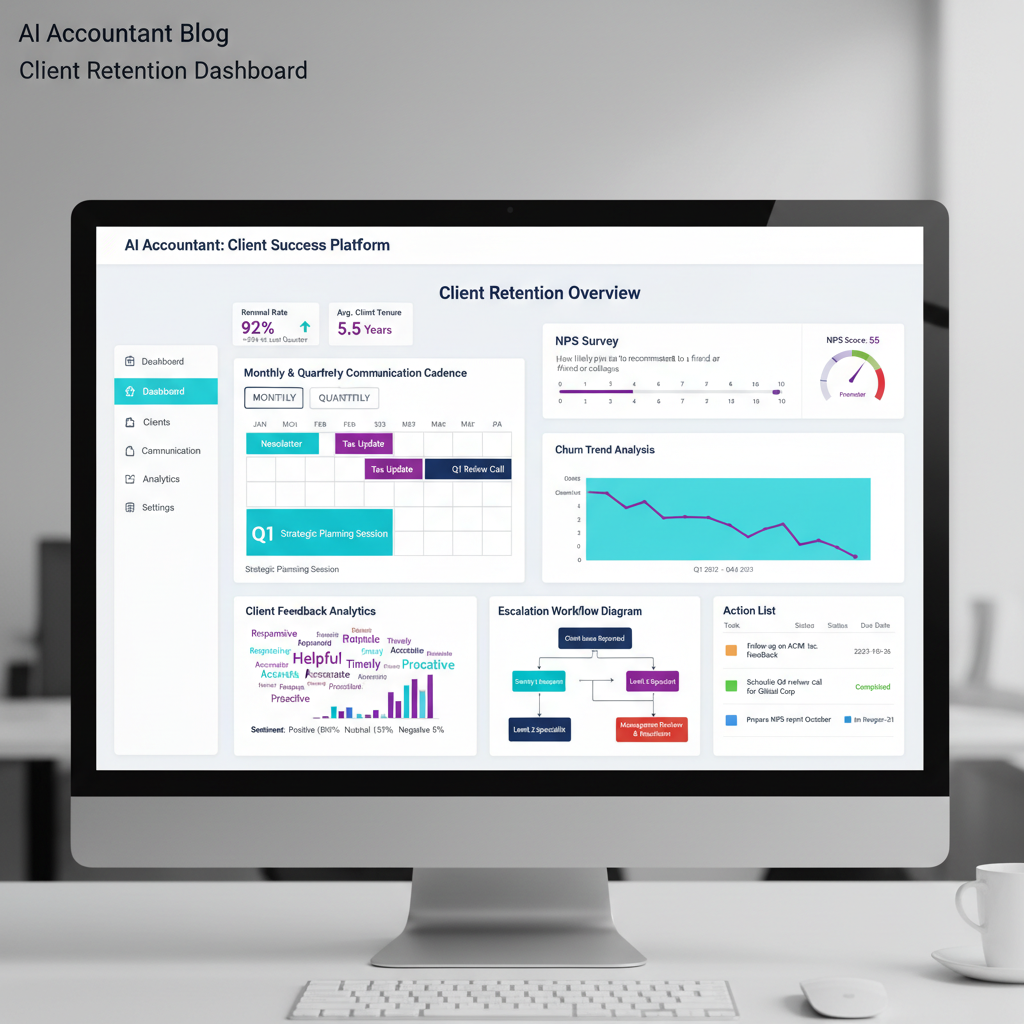
Creating Your Management Dashboard
Show retention health, cadence compliance, satisfaction and engagement, and red alerts in one view. Tools like AI Accountant can pull Tally and Zoho Books data to automate it, while practice managers like QuickBooks, Xero, FreshBooks, or Karbon track workflows and insights.
Build your dashboard to answer four questions at a glance: which clients are healthy, which need attention, which reviews are overdue, and which escalations are open. If you can answer those in under 30 seconds, your dashboard is working.
Indian Context Adaptations
Aligning to GST Filing Cycles
Let the 8th and 10th drive your rhythm. Kick off nightly reconciliations on the 5th, schedule monthly reviews on the 7th to finalize liability estimates, file GSTR 1 on the 8th, perform spot checks on the 9th, and file GSTR 3B on the 10th. Follow up by the 15th if issues arise.
Use a GST readiness checklist that compiles GSTR 1 totals, ITC claims, supplier reconciliation percentages, and discrepancy flags with owners and due dates. The GST portal's auto-populated returns now pre-fill much of this data, but reconciling those auto-populated figures against your books is where most errors hide.
For clients on the QRMP scheme (quarterly filing with monthly payment), adjust your cadence to focus monthly reviews on payment adequacy and cash flow, reserving the detailed filing reconciliation for the quarter end review.
Managing Tally and Zoho Books Integration
Automate data sync 24 to 36 hours before reviews. Verify last transaction dates. Flag any sync delays in the pre read with links to current dashboards.
Common sync issues include mismatched ledger names between Tally and your reporting tool, or transactions posted after the sync window. Build a five minute sync verification step into your analyst's pre read workflow.
Creating Engaging Pre Reads
Keep the executive summary to one page. Highlight three decisions. Use visuals and plain English.
"You have 1.80 rupees in short term assets for every rupee of short term debt. This is healthy."
Offer bilingual summaries when useful, and provide links to live dashboards. Founders and CFOs scan, they don't read. Make the first three lines count.
Handling Peak Season Pressures
Set expectations in Q4. Shorten monthly reviews to 20 minutes, extend email response times to 48 hours, and defer non urgent requests to May.
Publish a peak season playbook with submission cutoffs, draft and final dates, and locked filing schedules. Bake peak season SLAs into engagement letters so there are no surprises when March hits.
According to PIB press releases, the government has been progressively tightening return filing deadlines and reducing extension windows, making advance preparation even more critical than in prior years.
Common Implementation Pitfalls
Pitfall: Ad Hoc Communication Only
Unscheduled interactions feel negative and erode trust. Fix by locking a 12 month calendar, holding firm on dates, and never skipping reviews. Consistency beats perfection.
Pitfall: Collecting Feedback Without Action
Silence after surveys breeds detractors. Enforce the 48, 7, 30 rule, and showcase changes in the next review. If you ask and then do nothing, you are worse off than if you never asked.
Pitfall: Unclear Escalation Paths
Ambiguity on owners and timelines causes lasting damage. Name owners immediately, share SLAs, update on cadence, document root cause and prevention.
Pitfall: Information Overload
Ten page pre reads get ignored. Use one page summaries, clear hierarchy, and optional appendices with links to dashboards. Less is more when your client is a founder juggling 15 things.
Pitfall: Inconsistent Team Communication
Conflicting messages drain patience. Assign a senior CA as primary owner, maintain continuity, use CRM and bookkeeping software notes, and run internal syncs before client reviews.
Technology Enablement Recommendations
The right stack makes cadence scalable. For Indian GST and banking workflows, choose accounting automation tools that integrate cleanly with your existing systems:
- AI Accountant, specializes in Indian SMB workflows and auto generates monthly pre reads and dashboards from Tally.
- QuickBooks, widely used for small business accounting and workflow tracking.
- Xero, popular for cloud based bookkeeping with strong bank feed integrations.
- FreshBooks, suited for service based firms and invoice management.
- Tally Prime, the backbone of Indian accounting with deep GST compliance features.
- Zoho Books, cloud accounting with Indian tax compliance built in.
Centralize communications with Teams or Slack. Track work with Asana or Monday. Maintain interaction history with HubSpot or Zoho CRM.
Use BI tools like Power BI, Tableau, Google Data Studio, or Zoho Analytics for client ready visuals. Secure document exchange is essential for sensitive data. Consider SecureFilePro, ShareFile, SmartVault, or locked down Google Drive and OneDrive.
Getting Started: Your 90 Day Sprint
Week 1 to 2: Setup and Customization
Customize review agendas, NPS surveys, escalation matrices, and email templates. Align language to your firm's voice.
Week 3 to 4: Calendar and Training
Book every monthly and quarterly review for 12 months. Schedule surveys and mark renewal conversations. Train partners, managers, and analysts on roles, SLAs, and dashboards.
Month 2 to 3: Pilot and Refinement
Pilot with your top 10 clients. Track attendance, NPS, and escalations. Refine templates, timing, and processes based on live feedback.
Month 4 Onward: Full Scale Rollout
Roll out by segments. Maintain quality over speed. Review firm wide metrics monthly. Celebrate quick wins to sustain momentum.
Sprint goal: Every client has monthly and quarterly reviews scheduled, and all feedback receives a response within 48 hours.
Conclusion
A structured client communication cadence, powered by monthly and quarterly reviews, NPS loops, and defined escalations, becomes your firm's backbone for retention. Clients feel valued, issues surface early, operations smooth out, and renewals become the default choice.
This is not about more meetings. It is about better ones.
Start with your top ten clients. Ship simple pre reads. Ask for feedback. Build consistency over perfection. The firms thriving today master communication discipline, and you can too.
FAQ
How should a CA firm structure monthly reviews to avoid overruns while still adding value?
Keep monthly reviews to 30 to 45 minutes with a time boxed agenda: five minutes each on cash, working capital, and compliance, ten on risks and quick wins, five on action items. Share a one page pre read 24 hours before the call. AI generated summaries from tools like AI Accountant cut prep time to minutes, keeping discussions focused on exceptions rather than data assembly.
What pre read metrics are must haves for Indian SMB clients during GST heavy months?
Include cash opening and closing balances with variance, AR and AP aging at 30 and 60 day buckets, bank reconciliation status, GSTR 1 and 3B readiness (including e-invoice IRN validation status for clients above ₹5 crore turnover), TDS payable, and top three exceptions. (2026 update) E-invoice status is now a pre read essential given expanded thresholds.
How do I map my cadence to GST due dates for minimal firefighting?
Start reconciliations on the 5th, run a review on the 7th, file GSTR 1 on the 8th, spot check on the 9th, and file GSTR 3B on the 10th. Automate reminders and pre read generation so nothing slips. Lock these as recurring calendar events. For QRMP clients, shift the detailed filing review to the quarter end while maintaining monthly payment adequacy checks.
What is a practical escalation matrix for a mid sized CA practice?
Use three tiers: tier one (account manager) acknowledges within four hours and resolves in 24, tier two (senior CA) calls within 12 hours and resolves in 48 to 120 hours, tier three (partner) meets within 24 hours for critical failures. Define SLAs, owners, and checkpoints for each tier. Run a post mortem within seven days of closure and share findings in the next review.
How quickly should we act on NPS or feedback to prevent detractors?
Acknowledge within 48 hours, share an action plan within seven days, and deliver a "You said, we did" update within 30 days. For scores 0 to 6, escalate to a partner immediately. Use your CRM to auto create tasks from survey submissions so nothing falls through the cracks.
What early warning indicators predict churn in CA firm client relationships?
The strongest early signals are a two point or greater NPS drop, review attendance falling below 80 percent, repeated SLA misses, delayed payments, and declining email response rates. Trigger partner outreach within 48 hours of spotting any of these. An executive check in to re anchor value costs far less than a lost client.
How can automation realistically save prep time for client reviews?
An automation tool connected to Tally extracts bank balances, AR and AP aging, compliance deadlines, and variance drivers, then generates an executive summary with exception flags. Teams spend minutes reviewing insights rather than hours compiling data. The key is nightly data sync so the pre read reflects yesterday's numbers, not last week's.

Rohan Sinha is a fintech and growth leader building aiaccountant.com, focused on simplifying accounting and compliance for Indian businesses through automation. An IIT BHU alumnus, he brings hands-on experience across 0 to 1 product building, growth, and strategy in B2B SaaS and fintech.