-01%201.svg)
Key takeaways
- Expense reimbursement automation in India digitizes the full claim to payment lifecycle, cutting processing time by up to 75 percent and shrinking reimbursement cycles from 8+ days to under 48 hours.
- For Indian SMBs, the must have capabilities are accurate GST extraction, native Tally sync, city and grade based policy engines, mobile first capture, and AI powered duplicate detection.
- Real ROI shows up in three places: 15 to 25 percent leakage reduction, 10 to 20 percent higher ITC recovery, and month end closings that finish 3 to 5 days sooner.
- If your finance team still chases Excel sheets and WhatsApp photos for claims, the cost of inaction grows every quarter through missed ITC, duplicate payouts, and audit risk.
- Platforms like AI Accountant combine OCR trained on Indian formats, GST compliance engines, and bi directional Tally posting so CA firms and finance teams can focus on analysis instead of data entry.
Expense Reimbursement Automation India: What's New in 2026
In 2025, most automated expense tools promised mobile capture and basic OCR. By 2026, the bar has moved significantly. Reimbursement cycles that averaged 5 to 8 days now routinely close within 48 hours thanks to AI driven validation, real time policy checks, and instant UPI payouts. Multi currency support has expanded too, with leading platforms processing claims in 70+ currencies for teams with international travel.
The bigger operational shift is around compliance. From April 2025, the GST e-invoicing threshold dropped to cover more SMEs, which means expense tools must now parse and validate e-invoice QR codes on a much larger share of vendor bills. If your system cannot auto verify QR authenticity and extract IRN details, you risk booking ineligible ITC that gets reversed during reconciliation. The GST portal's e-invoice framework now expects businesses to maintain validated digital trails for every B2B transaction above the threshold.
Who does this hit hardest? CA firms managing 10+ client entities and SME finance teams processing 500+ claims monthly. For them, manual validation is no longer feasible at scale. The cost of inaction is tangible: blocked ITC claims, penalty interest under Section 50, and compliance flags during departmental audits.
What to do now:
- Audit your current expense tool's e-invoice QR parsing, if it only reads text and ignores the QR, flag it as a gap.
- Verify that your system auto blocks ITC on invoices missing GSTIN or company name before claims reach the approver.
- Test AI anomaly detection by submitting edge cases: two similar cab rides, a weekend hotel bill, a vendor with cancelled registration.
For firms already using GST reconciliation automation, the expense module now feeds validated claim data directly into GSTR 2B matching, closing the loop between reimbursements and return filing without manual re-entry.
What Is Expense Reimbursement Automation in India
Expense reimbursement automation India refers to software that digitizes, validates, approves, and records employee claims while honoring Indian tax rules. Think of it as an assistant that never sleeps, never miscalculates, and always remembers GST compliance.
This sits under the broader umbrella of employee expense management, and focuses on the claim to payment lifecycle:
- Capture: Employees photograph receipts or upload digital bills. OCR trained on Indian formats extracts data, including regional language invoices.
- Validate: Automated checks verify GST numbers, detect duplicates via fuzzy matching, and flag policy violations before approval.
- Approve: Configurable workflows route claims by amount, category, and hierarchy.
- Reimburse: Automated payouts via bank transfer, UPI, or payroll integration. Leading tools now close payouts within 48 hours.
- Record: Seamless posting to accounting systems like Tally with proper GST coding and ledger mapping.
Result: fewer errors, faster closing, tighter controls, better visibility.
India Specific Considerations
- GST compliance: ITC rules are nuanced. Invoices must carry company name and GSTIN. Restaurant bills at 5 percent do not allow ITC. The CBIC GST FAQ page details these restrictions clearly.
- Multi language receipts: OCR must work across Hindi, Tamil, and other regional formats. In 2026, AI models handle handwritten and damaged receipts with measurably better accuracy.
- Tally integration: Indian SMBs rely on Tally. Bi directional sync is essential for ledgers, voucher types, and GST returns.
- Travel patterns: City tier allowances, grade linked rules, regional variations in per diem rates.
- E-invoice validation: With the lowered threshold, more vendor bills carry mandatory QR codes. Your tool must validate these against the GST e-invoice portal standards.
Core Components to Demand in Expense Reimbursement Automation
Receipt validation software that actually works
- GST details extraction: Auto pull GSTIN, invoice number, date, HSN or SAC, taxable value, CGST or SGST or IGST. Manual entry defeats the purpose of automation.
- Duplicate detection: Catch repeats by amount, date, vendor, UPI reference IDs. Flag the same cab ride submitted twice. In 2026, fuzzy image matching and EXIF metadata checks add another layer.
- Vendor verification: GSTIN format checks, e-invoice QR parsing, flag unregistered or cancelled vendors to protect ITC.
- Broad format support: Printed invoices, UPI screenshots, fuel and toll receipts, hotel folios, and digital payment confirmations.
- Mobile optimization: Offline capture, image quality feedback, fewer resubmissions.
Policy compliance engine for Indian business rules
- City and grade based limits: Mumbai versus Pune allowances, travel class by level, dynamic per diems adjusted by tier.
- GST compliance rules: Block ITC if company name is missing, handle restaurant 5 percent without ITC, apply Section 17(5) restrictions automatically.
- Exception handling: Soft blocks with manager override, hard blocks for violations, audit trail for all exceptions.
- Time and merchant controls: Weekend meal restrictions, bill age limits, approved vendor lists, project and cost center validations.
Reimbursement workflow that matches your organization
- Multi level approvals: Manager approval, finance verification, delegation when approvers travel.
- Advance management: Request, approve, and auto settle against expenses with clear tracking of outstanding balances.
- Payment options: Payroll credit, bank transfer, UPI. Real time status updates for employees reduce follow up queries.
- Accounting integration: Bi directional sync with Tally, auto journals with GST splits, correct voucher types.
- Audit trail: End to end claim history and document retention with timestamps.
Integration ecosystem for seamless operations
- Accounting systems: Native Tally sync in real time, not just CSV exports.
- HRMS connectivity: Employee data and org charts sync automatically. New hires appear instantly in the expense system.
- Corporate cards: Auto import and categorize transaction feeds.
- Travel management: Pull bookings from OTAs and TMCs to pre populate expenses and reduce manual entry.
- GSTN integration: Vendor validation and invoice authenticity checks against government records.
Management dashboards and analytics
- Spend Analytics: Category, team, and project views, trend lines, budget variance alerts.
- Policy compliance: Violation rates, exception trends, policy effectiveness scores.
- GST and ITC Tracking: Eligible versus blocked ITC, aging, reconciliation readiness for GSTR 2B matching.
- Process efficiency: Cycle time, bottlenecks, close acceleration metrics.
- Employee experience: Adoption rates, satisfaction indicators, mobile usage trends.
India Specific Compliance Essentials
GST compliance is non negotiable. Penalties are real. Documentation is key.
- Input Tax Credit rules: ITC only when invoices carry company name and GSTIN. The system should auto block non compliant claims before they reach finance. The CBIC notifications portal publishes updates to these rules regularly.
- E-invoice requirements: QR codes are mandatory for eligible B2B transactions above the threshold. Validate format and authenticity automatically.
- Section 17(5) restrictions: Motor vehicle related expenses are often blocked from ITC. Apply rules by expense category so employees are not surprised at rejection.
- Documentation: Maintain originals in retrievable digital form for audits. Ensure retention periods and searchability meet your CA's requirements.
- Reimbursement versus allowance: Different tax treatment applies. Bill backed reimbursements are non taxable when compliant. Allowances without bills are taxable. Handle both correctly in your system.
Shortlist Checklist, Key Features to Evaluate
- Receipt processing accuracy: Test real Indian receipts in multiple languages. Verify GST field extraction, duplicate catching, and handwritten receipt handling.
- Policy engine flexibility: City tiers, grade limits, Section 17(5) scenarios, restaurant bills at 5 percent, weekend and time based restrictions.
- Workflow customization: Delegation, escalations, emergency approvals, budget based routing.
- Accounting integration depth: Real time Tally sync, correct ledgers and GST splits, voucher type mapping.
- Mobile experience: Intuitive, offline ready, quality prompts, real time claim tracking.
- Security and compliance: ISO 27001, SOC 2 Type II, detailed audit logs, India data residency options.
- Implementation and support: Local expertise, CA firm references, transparent pricing, dedicated onboarding support.
Demo Script, What to Test Before You Buy
- GST compliance test: Submit a hotel bill without company name. ITC should be auto blocked and routed for review, not silently accepted.
- Duplicate detection: Submit two similar cab bills on the same date and route. The system should flag instantly using fuzzy matching, not just exact amount matching.
- UPI screenshot handling: Upload a UPI payment screenshot. Verify auto categorization, limit application, and ITC restriction where applicable.
- Advance and settlement: Test the full cycle: request, approval, expense submission, auto adjustment, and over or under settlement handling.
- Tally integration: Verify ledger postings, GST splits (CGST, SGST, IGST), employee advance vouchers, and vendor master mapping.
- Policy violations: Test weekend meals, amount limits above grade, unapproved vendors. Observe escalation paths and audit trail completeness.
- Multi currency test: Submit a foreign travel claim. Check exchange rate sourcing, INR conversion accuracy, and accounting treatment.
- AI anomaly detection: Submit an expense from a vendor whose GSTIN was recently cancelled. Verify the system flags the risk before approval.
ROI Calculation Model for Indian Businesses
Build a clear business case combining hard and soft benefits.
- Time savings: Manual processing to approval to Tally posting. Expect 60 to 75 percent reduction. For a 300 employee company processing 800 claims monthly, this frees 8 to 10 finance hours per week.
- Leakage reduction: Fewer duplicates and policy violations. Often 15 to 25 percent improvement in total claim accuracy.
- ITC recovery: Better documentation and validation raises eligible ITC by 10 to 20 percent. On ₹50 lakh annual expenses, that is ₹5 to 10 lakh in recovered tax credits.
- Month end acceleration: Close faster by 3 to 5 days. Improve reporting cadence for management and statutory filings.
- Compliance cost reduction: Fewer audit adjustments, fewer penalties, lower CA firm effort on cleanup work.
- Employee experience: Faster reimbursements within 48 hours instead of 8+ days. Fewer HR complaints, better retention.
Typical payback: 6 to 18 months depending on volume and current process maturity.
90 Day Implementation Roadmap
Weeks 1 to 2, foundation setup
Define expense categories aligned with your Tally chart of accounts. Set limits by grade and location. Map approval hierarchies and exception paths. Configure GST rules including Section 17(5) blocks and e-invoice QR validation.
Weeks 3 to 4, pilot testing
Pilot with frequent travelers and field staff. Import historical data to validate OCR accuracy. Refine policies based on real exceptions. Train pilot users, collect feedback, iterate quickly.
Weeks 5 to 8, system integration
Complete Tally setup: map ledgers, GST codes, employee advance accounts, vendor masters. Test bi directional sync thoroughly. Finalize payment workflows including UPI and payroll integration. Connect HRMS for automatic org chart updates.
Weeks 9 to 12, full rollout
Train all employees with hands on sessions. Launch management dashboards. Set up support channels and feedback loops. Track adoption metrics weekly and celebrate early adopters.
Start small, learn fast, scale confidently.
Expense Reimbursement Software Comparison
Consider these India focused platforms when shortlisting:
- AI Accountant: Specialized for Indian SMBs and CA firms. Deep Tally integration, GST compliance engine, strong OCR, reconciliation, and multi org support. ISO 27001 and SOC 2 Type II certified.
- Itilite: Corporate travel and expense combined. Robust policy engine with multi currency support.
- Zaggle: Fintech approach with prepaid cards, rewards, and expense tracking in one platform.
- Refrens: Custom expense categories with global payout support in 70+ currencies.
- ExpensePro: Prepaid card based expense management with fuel and fleet tracking.
- Paybooks: Built around Indian statutory compliance and payroll integration.
Compare strengths to your accounting stack, team size, and adoption readiness.
Manual vs Automated Expense Management
| Approach | Pros | Cons |
|---|---|---|
| Manual Excel or Email process | No upfront software cost, full control, familiar to employees | Time intensive (8+ days per cycle), error prone, poor auditability, slow month end, GST gaps, missed ITC |
| Basic expense apps | Digitization, mobile capture, basic approvals | Limited GST support, weak Tally sync, generic policies, no anomaly detection |
| Specialized Indian automation (2026) | Deep GST compliance, native Tally sync, AI OCR with multi language support, sub 48 hour reimbursements, robust audit trails, multi currency | Higher upfront investment, change management required, initial configuration effort |
Real World Implementation Success Story
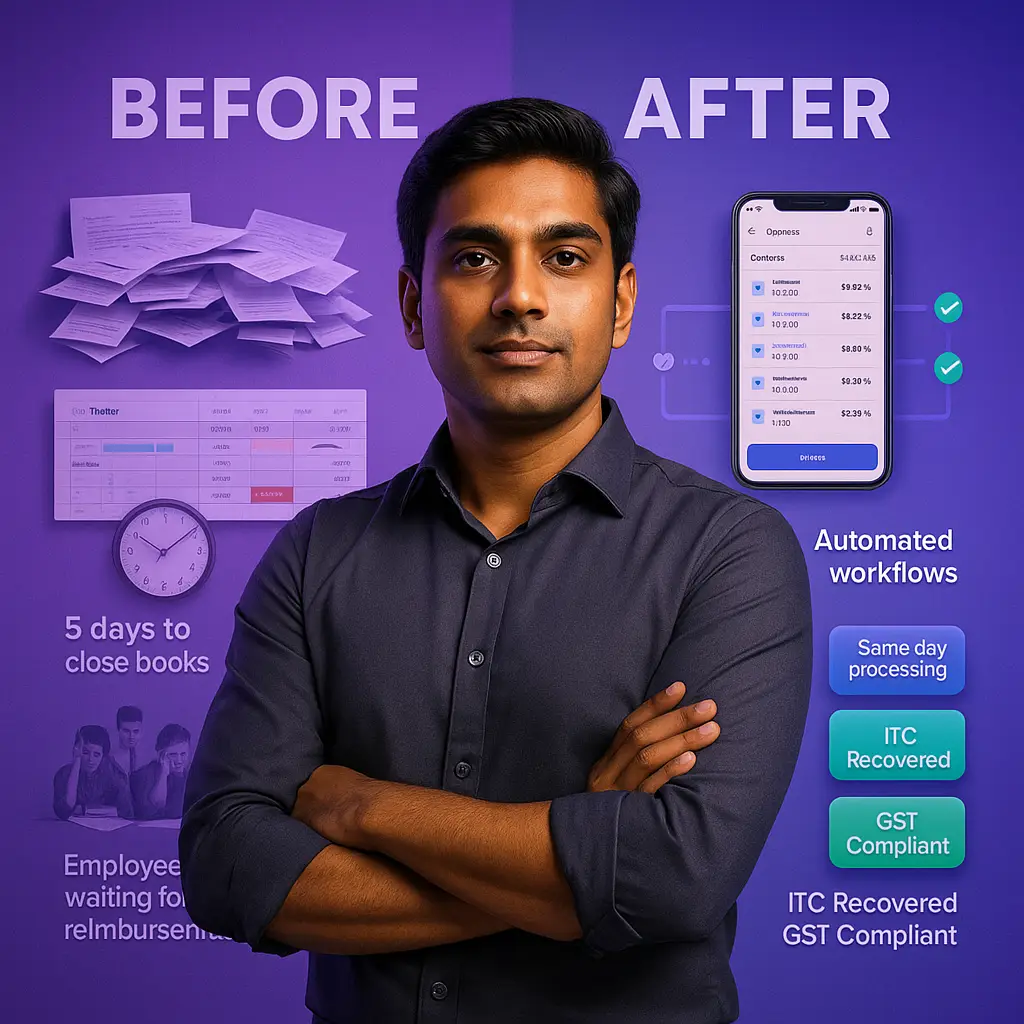
Before: A 300 employee FMCG distributor processed 800 plus claims monthly. Finance spent two full days on manual verification. Duplicates were common. Hotel ITC was often missed due to incomplete invoices. Monthly closing lagged by seven days.
After six months: Duplicate claims dropped to near zero. ITC eligibility rose above 90 percent. Processing time fell 65 percent. Books now close in three days instead of ten.
Unexpected benefits: The CA firm delivers monthly spend analytics to the founder. Employees report higher satisfaction with quick payouts. Statutory audits finish faster with complete digital trails.
Common Implementation Challenges and Solutions
- Low employee adoption: Make the app easier than the current process. Provide hands on training sessions. Celebrate early adopters publicly. Show employees their reimbursement is now faster.
- Policy complexity: Start simple with 5 to 7 core rules. Handle edge cases via exception workflows. Expand rules gradually based on violation data.
- Data migration: Clean masters first. Streamline categories and approval hierarchies before importing.
- Integration hiccups: Involve IT early. Allocate extra testing time for Tally sync, especially around GST splits and voucher types.
- Change resistance from finance teams: Position automation as freeing finance for analysis and advisory work. Include them in system design and rollout decisions.
Measuring Success, KPIs for Expense Automation
- Processing efficiency: Submission to reimbursement time (target under 48 hours), straight through processing percentage, claims per finance FTE.
- Policy compliance: Violation rates by category and persona, exception approval rates, duplicate detection hit rate.
- Financial impact: Leakage reduction in rupees, ITC uplift percentage, close time improvement in days.
- User experience: Employee satisfaction scores, mobile usage rate, support ticket volume and resolution time.
- Audit readiness: Complete documentation rate, audit adjustment count, compliance score trend.
Advanced Features for Growing Businesses
- Predictive analytics: Forecast spend by department, detect anomalies early, suggest policy refinements based on data patterns.
- Advanced OCR with AI: Better accuracy for handwritten, damaged, or regional language receipts. Continuous model improvement.
- Dynamic approvals: Route by budget availability, risk scoring, and real time spend thresholds.
- Integration expansion: Procurement three way matching, project cost allocation, BI tool connectors for executive reporting.
- Multi entity support: Inter company allocations, consolidated group views, multi currency processing for international operations.
Security and Data Protection Considerations
- Data encryption: End to end, at rest and in transit, AES 256 standards minimum.
- Access controls: Role based permissions, least privilege principle, segmented views by entity and department.
- Audit logging: Tamper proof activity trails for compliance and forensic review.
- India data residency: Keep data within Indian borders if organizational or regulatory policy requires it.
- Backup and recovery: Tested restore procedures with documented RPO and RTO targets.
- Compliance certifications: ISO 27001 and SOC 2 Type II signal vendor maturity and commitment to data protection.
Next Steps, Getting Started with Expense Automation
- Week 1: Document your current process end to end. Estimate time spent, leakage rate, and missed ITC.
- Week 2: Define requirements using the shortlist checklist above. Involve finance, HR, and IT stakeholders.
- Week 3: Shortlist three to four vendors with proven Indian GST and Tally strengths. Test mobile apps personally.
- Week 4: Run demos with your real receipts and policies. Use the demo script above. Do not accept canned demos.
- Weeks 5 to 6: Check references from similar sized companies. Validate support quality and realized ROI numbers.
- Weeks 7 to 8: Negotiate pricing, finalize implementation timeline, lock training scope and integration milestones.
If you already use AI Accountant for bookkeeping automation, the expense module plugs into your existing flows, from bank reconciliation to reimbursements.
Compliance note: GST and reimbursement rules change periodically. Consult your CA for current guidance and monitor gst.gov.in for the latest notifications.
Sources and further reading
- GST Portal, Government of India
- GST E-Invoice Portal
- CBIC Notifications and Circulars
- ICAI, Institute of Chartered Accountants of India
- Tally integration with AI Accountant
FAQ
How is expense reimbursement automation different from broader employee expense management
Expense reimbursement automation targets the employee claim lifecycle specifically: submission, validation, approval, payment, and ledger posting for out of pocket spends. Broader employee expense management also covers corporate cards, vendor payments, travel pre approvals, and budgeting. Many Indian businesses start with reimbursement automation and expand from there.
Can a company claim GST ITC on employee expenses and what invoice details are mandatory
Yes, ITC is claimable if the invoice shows the company name, GSTIN, invoice number, date, GST breakup, and supplier GSTIN. Restaurant bills at 5 percent and motor vehicle expenses under Section 17(5) are commonly blocked. Your automation tool should enforce these rules at the point of submission so ineligible claims never reach finance.
How should a CA evaluate Tally integration depth during vendor demos
Post a sample expense from the tool and verify the exact entry in Tally: correct ledger, voucher type, CGST or SGST or IGST split, employee advance adjustment, and posting narrative. Also test reverse sync, if someone edits a ledger in Tally, does the expense tool reflect it? Bi directional accuracy is the real test, not one way export.
What duplicate detection checks are most effective for Indian receipts
Multi factor matching works best: amount, date, merchant name, UPI reference IDs, invoice numbers, and fuzzy image comparison. In 2026, AI models also check EXIF metadata and flag similar cab rides on the same day across different employees (2026 update). Ask vendors to demonstrate this with real scenarios, not scripted demos.
How fast should reimbursements reach employees with automation
With specialized Indian automation tools in 2026, reimbursements should reach employees within 48 hours of submission for policy compliant claims (2026 update). This compares to 8+ days in manual processes. The speed comes from instant OCR validation, auto policy checks, and UPI or bank transfer payouts triggered immediately after approval.
What is a realistic timeline to go live for a 300 employee multi location company
Plan 8 to 12 weeks using a phased approach. Two weeks for setup and configuration, two weeks for pilot testing with frequent travelers, three to four weeks for full Tally integration and training, then a phased rollout. Build slack for Tally sync testing and change management, especially if you have multiple GSTINs or entities.
What security certifications should we demand from an expense automation vendor
At minimum, require ISO 27001 and SOC 2 Type II certifications, which demonstrate audited security controls. Also verify end to end encryption, India data residency options, role based access controls, and tamper proof audit logs. These are especially important for CA firms handling multiple client entities with sensitive financial data.

A results-driven finance and sales professional with hands-on experience through finance internships and a fast-paced sales role. With a strong interest in accounting and business finance, Harsh focuses on turning complex topics into clear, practical takeaways for founders and finance teams.