-01%201.svg)

Key takeaways
- Generic converters struggle with Indian bank layouts, specialized bank statement OCR India tools deliver accuracy, speed, and reliability.
- Prioritize solutions trained on Indian formats, with 99 percent plus field accuracy, robust narration parsing, and running balance continuity.
- Validation, reconciliation, and anomaly detection are non negotiable for audit ready data, not just extraction.
- API first, bulk processing, and direct Tally or Zoho sync are essential for CA firms processing hundreds of statements monthly.
- Verify ISO 27001 and SOC 2 Type 2, encryption, audit logs, and India data residency to protect financial data.
- Run a structured pilot on 50 plus statements across banks, measure accuracy gains and time saved to quantify ROI.
Why Bank Statement OCR India Matters More Than Ever
Indian finance teams juggle SBI, HDFC, ICICI, and more, each with its own table structure, narration style, and bilingual quirks. Password protected PDFs, poor scans, and multi page tables make manual work slow and error prone. Generic PDF to Excel tools miss UTR, IFSC, GST flags, and running balances, which leads to reconciliation delays.
Specialized bank statement OCR India platforms are trained on Indian formats, they recognize NEFT, IMPS, UPI patterns, parse GST annotations, and keep balances intact, which cuts manual classification by 60 to 75 percent for CA firms. Month end closes become faster, compliance gets smoother, and teams focus on review instead of typing.
Must Have Capabilities for Indian Bank Statement OCR
High Accuracy OCR for Complex Layouts
Indian statements include merged cells, multi line narrations, and carried forward rows. Your OCR must detect tables reliably, stitch across pages, and preserve transaction integrity. Aim for more than 99 percent field accuracy on dates and amounts, more than 98 percent line accuracy end to end, and continuous running balances. It should handle watermarks, stamps, and low resolution scans gracefully, as covered in OCR in banking and this India specific parser guide.
Comprehensive Indian Bank Coverage
Coverage must include SBI, HDFC, ICICI, Axis, Kotak, Yes Bank, IDFC, and Indian Bank, with current, savings, and cash credit statements. Expect automatic handling of password protected PDFs, and reliable parsing of UPI IDs, IMPS and NEFT references, as detailed in this bank coverage checklist.
Validation and Reconciliation Features
Extraction is the start, validation seals the value. The platform should verify opening and closing balances, match debit and credit totals, and deduplicate on UTR. Smart anomaly detection flags unusual patterns for review. Learn how to triage exceptions with reconciliation exception management in India. Complete audit trails are essential for compliance.
Performance at Scale
CA firms need API first automation, batch uploads, and queue management. Track processing speed per statement, concurrent throughput, and uptime during month end peaks. The best tools accept PDFs, scans, CSV, and Excel, then normalize in the background, as outlined here, performance benchmarks for India workflows.
Security and Compliance Standards
Demand ISO 27001 and SOC 2 Type 2, at rest and in transit encryption, India data residency, granular access controls, and tamper proof audit logs. See the security checklist for Indian finance data for specifics.
Your Evaluation Checklist for Bank Statement OCR India
- Bank coverage: SBI, HDFC, ICICI mandatory, plus Axis, Kotak, Yes Bank, IDFC, Indian Bank, support for current, savings, cash credit, password protected PDFs and poor scans.
- Accuracy benchmarks: more than 99 percent on dates and amounts, more than 98 percent line accuracy, uninterrupted running balances, resilience on low resolution scans.
- Table detection: merged cells, multi line narrations, carry forward across pages, preserve transaction integrity.
- Output flexibility: Excel, CSV, JSON, direct ledger posting, chart of accounts mapping suggestions.
- Integrations: bi directional Tally, seamless Zoho Books, India specific ledger mapping, AR or AP automation.
- Security: ISO 27001, SOC 2 Type 2, India residency, audit logs, least privilege access.
- Trial: pilot with 50 statements, mixed banks and quality, measure accuracy and time saved, run blind checks.
Comparing Technology Approaches
Generic PDF to Excel Converter Tools
Tempting for low cost and quick setup, but Indian layouts break them. They miss UTR, IFSC, GST, and multi line narration context, which means hours of cleanup.
If your team fixes more than 10 percent of lines after export, the tool is not fit for Indian statements.
Open Source OCR with Custom Scripts
Flexible for tech teams, but ongoing format changes across banks make maintenance costly. Without a dedicated engineering pod, accuracy drifts and support becomes a bottleneck.
BPO and Outsourced Data Entry
Human operators can be accurate, yet cost scales with volume, turnaround is slow, and data privacy risks rise. Not ideal for fast growing SMBs or multi client CA firms.
Specialized Bank Statement OCR India Solutions
Purpose built platforms trained on Indian formats balance accuracy, speed, and scale. Continuous template updates, Tally and Zoho integrations, and enterprise security deliver the best ROI.
Real World Tool Recommendations
- AI Accountant built for Indian SMBs and CA firms, with Indian bank trained OCR, Tally or Zoho sync, and enterprise security.
- QuickBooks accounting led statement imports for simpler workflows.
- Zoho Books native statement import, OCR quality varies by bank format.
- FreshBooks reconciliation features with limited OCR for standard layouts.
- Tally Prime statement import available, often requires manual mapping and correction.
For comprehensive Indian statement processing, specialized tools outperform generic importers.
Where AI Accountant Fits in the Landscape
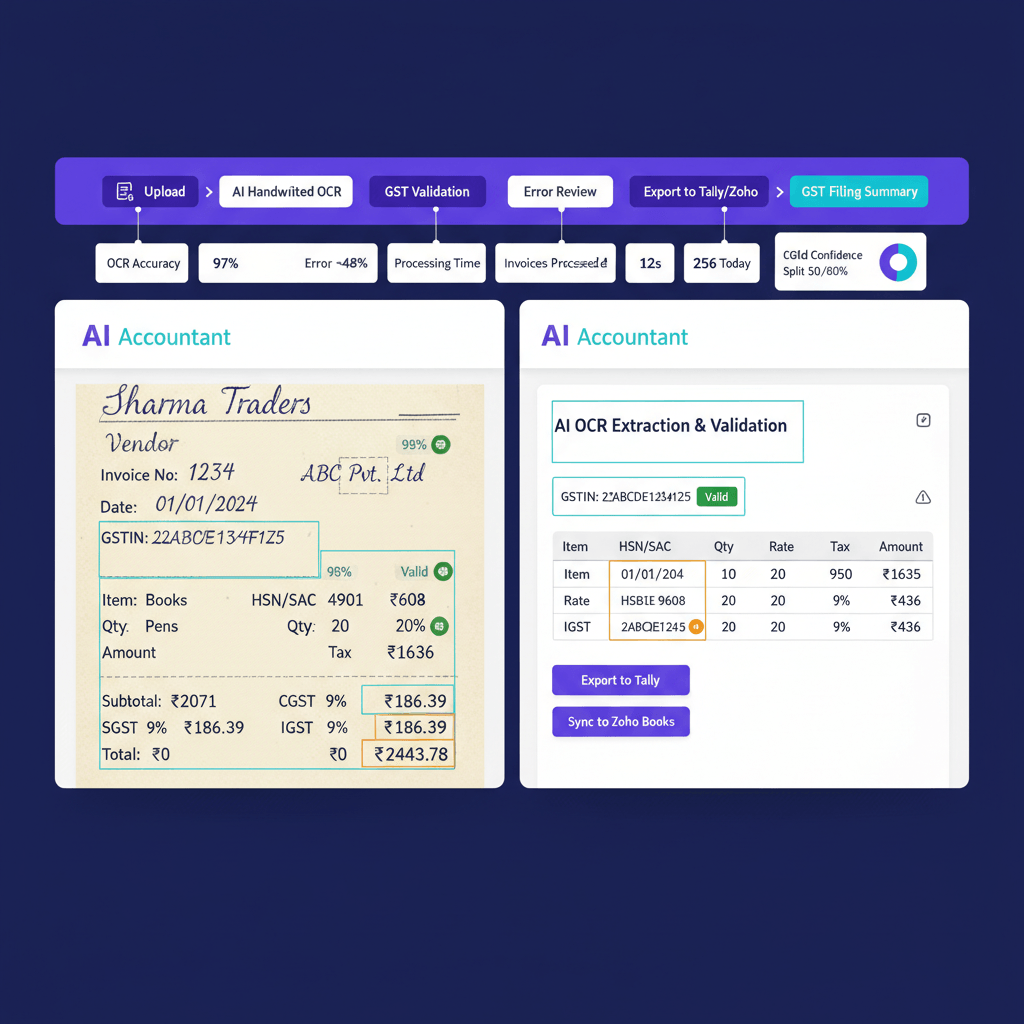
AI Accountant exemplifies the specialized approach. OCR and NLP models are trained on Indian statements from SBI, HDFC, ICICI, Axis, Kotak, Yes Bank, IDFC, and Indian Bank. It handles native PDFs, scans, CSV, and Excel with equal reliability. Multi line narrations parse correctly, UPI or IMPS or NEFT are recognized, and GST annotations are captured, as explained in smart narration parsing and this bank statement parser overview.
The workflow is end to end, upload, extract, validate, export to Excel or CSV, and sync to Tally or Zoho. Security is enterprise grade with ISO 27001 and SOC 2 Type 2, plus comprehensive audit logs. With hundreds of millions of transactions processed for many CA firms, scale is proven. India specific controls like UTR and IFSC normalization, running balance checks, and anomaly flags reduce review time dramatically.
Tackling Table Detection Challenges Unique to India
Merged narration cells, carried forward totals across pages, multi page stitching, signature overlays, and stamps are common in Indian statements. Generic OCR often splits single transactions into multiple rows or drops context when tables break over pages. Purpose built models, trained on these artifacts, preserve transaction integrity and resist visual noise, as highlighted in OCR in banking and this India focused deep dive.
Narration Parsing, The Hidden Challenge
UPI strings pack payer name, UPI ID, and reference in one field, NEFT includes beneficiary, IFSC, and branch, and GST annotations sit inline. Bilingual lines mix English and regional languages. You need context aware extraction that identifies entities, tags references, and joins multi line entries correctly. See narration parsing for Indian statements for patterns and examples.
Integration and Workflow Optimization
Instant Sync with Accounting Systems
Direct posting to Tally and Zoho turns extraction into reconciled books. Intelligent ledger mapping should learn from history, auto tag vendors and customers, and queue approvals before posting. Explore ledger mapping automation for Tally and Zoho to reduce classification time.
Bulk Processing for Scale
Batch uploads, multi entity management, and scheduled queues let CA firms process hundreds of statements overnight. Upload once, process in parallel, and review exceptions next morning. This shifts the team from data entry to oversight.
Dashboard and Reporting
Real time cash flow, revenue versus expense trends, and AR or AP aging should refresh as statements post. Management sees insights without waiting for period end reports.
Tip: Use anomaly flags to drive targeted reviews, not blanket checks.
Security and Compliance Deep Dive
Look for ISO 27001 with documented ISMS, and SOC 2 Type 2 proving controls are effective over time. Enforce AES 256 at rest and TLS 1.2 plus in transit, with key rotation. Role based access, MFA, session timeouts, and least privilege protect sensitive data. Tamper proof audit logs track every extraction and change. If you need data localization, confirm India data residency, as reiterated in this security and compliance guide.
ROI Calculation and Expected Outcomes
Automating a 20 page statement saves hours per file, multiplied by hundreds per month for CA firms. Error rates drop, month end closes finish sooner, and teams scale without linear headcount. Most firms report 60 to 75 percent reduction in manual classification within three months, as compiled in this ROI analysis.
Bottom line: Faster processing, fewer errors, better compliance, and improved decision speed.
Case Studies, Real Implementation Stories
Manufacturing company with SBI heavy banking
Scanned PDFs and poor image quality plagued accuracy. Specialized OCR achieved 99.2 percent extraction, maintained running balances, and auto tagged GST for input tax credit, which simplified filing.
D2C brand with multi bank complexity
Eight entities and multiple banks overwhelmed a small team. Bulk processing and direct Tally sync turned a week of work into hours, freeing time for cash flow optimization.
Services firm with ICICI transaction volumes
Thousands of UPI and NEFT lines per month created duplicate and matching issues. UTR normalization and narration intelligence cut reconciliation time by 80 percent and accelerated reporting.
Practical Evaluation Steps
Request a structured trial
Use at least 50 real statements across banks, include password protected PDFs, messy scans, and complex narrations. Score field accuracy, line completeness, and balance continuity against ground truth.
Pilot workflow integration
Push outputs to Tally or Zoho, validate ledger mapping, approvals, and reconciliation speed. Time the end to end journey, upload to reconciled books, to estimate ROI accurately.
Evaluate support and onboarding
Test response times, clarity of documentation, and availability of success resources. Teams adopt faster when training and handholding are strong.
Security and compliance verification
Review ISO and SOC reports, data storage locations, encryption standards, retention, and SLAs. Confirm data ownership and liability clauses before rollout.
Implementation Best Practices
- Start with a focused pilot, for example one entity or one bank, prove value, then scale.
- Standardize statement collection and naming, centralize uploads, automate email forwarding where possible.
- Train users, appoint champions, and provide quick reference guides.
- Set review workflows for high value or unusual items, leverage anomaly flags for targeted checks.
- Track accuracy trends, report format issues for rapid template updates, and iterate continuously.
- Plan for scale from day one, validate pricing at higher volumes, and test peak performance.
The Path Forward
Manual processing cannot keep up with Indian banking complexity and growing volumes. Specialized OCR trained on Indian layouts, with strong validation and seamless Tally or Zoho integration, transforms finance operations. Use the checklist, test with your worst cases, verify security, and compute ROI. Empower your team to analyze, while automation types.
Take Action Today
Download and customize the buyer checklist, shortlist vendors, and run structured trials. Measure accuracy, time saved, and reconciliation speed. Watch a full workflow demo to see statements turn into reconciled ledgers. The sooner you automate, the sooner you benefit. For a detailed primer, see this bank statement parser guide for India.
FAQ
Does a specialized bank statement OCR actually support password protected PDFs from SBI, HDFC, and ICICI out of the box
Yes, leading India focused tools decrypt password protected PDFs during processing without exposing credentials, then extract transactions reliably across banks. Solutions such as AI Accountant have templates for major Indian formats and handle both native PDFs and scans.
How can a CA firm validate the claimed 99 percent plus field accuracy before buying
Run a 50 statement pilot using your toughest documents, include poor scans and multi page layouts, then compare extracted dates and amounts against ground truth on a random sample. Ask for accuracy logs and balance continuity reports. AI Accountant provides pilot scorecards that quantify field and line level accuracy.
Will the OCR handle multi line narrations with UPI IDs, IFSC, and GST in the same description
Choose a tool with narration NLP trained on Indian statements. It should join multi line entries, tag UPI IDs and references, extract IFSC, and isolate GST annotations. AI Accountant’s narration parsing models are tuned on Indian UPI or NEFT patterns and bilingual lines.
Can the extracted data post directly to Tally with correct ledger mapping and approvals
Yes, shortlist platforms that support bi directional sync with Tally, offer learned ledger mapping, and provide approval queues. In practice, AI Accountant learns from prior categorizations, suggests ledgers, and lets reviewers approve before posting.
How does the system avoid duplicate entries when clients resend the same statement or when UTR repeats across files
Use UTR based deduplication, combined with date, amount, and narration checks. Good systems also track opening and closing balances per file and per account. AI Accountant normalizes UTRs and flags suspicious duplicates automatically.
What performance metrics should a CA principal track during month end crunch
Monitor processing time per statement, concurrent throughput, queue wait times, and error or exception rate. Track uptime during peaks and the percentage of transactions auto approved. AI Accountant dashboards expose these metrics in real time.
Is India data residency available, and what encryption standards are expected for compliance
For regulated clients, insist on hosting in India regions with AES 256 encryption at rest and TLS 1.2 plus in transit. Verify ISO 27001, SOC 2 Type 2, and tamper proof audit logs. AI Accountant offers India residency options with enterprise controls.
How should I compute ROI for a mid sized CA firm processing 200 statements a month
Calculate hours saved, manual entry per statement versus automated processing, add rework reduction from fewer errors, then include opportunity value from faster closes. Most firms see payback within the first quarter. AI Accountant typically delivers 60 to 75 percent reduction in manual classification effort.
What is the best way to test table detection on merged cells and carried forward totals
Assemble statements with merged narration cells and multi page tables. Verify that each transaction remains a single row in the export and that running balances reconcile page to page. AI Accountant includes carried forward handling and cross page stitching in its parser.
Will the solution recognize and tag GST charges for input tax credit automatically
Yes, if it is trained on Indian formats. It should detect GST descriptors in narrations, capture tax amounts, and export fields needed for ITC workflows. AI Accountant auto captures GST annotations and supports downstream GST reporting.
Can we integrate with Zoho Books without manual CSV shuttling every week
Look for direct API integrations that push transactions into Zoho Books with ledger mapping and vendor or customer tagging. AI Accountant supports direct sync, which removes manual CSV uploads.
How do anomaly flags work in practice for review gates at a CA firm
Anomaly modules score transactions for unusual dates, amounts, or patterns, then route them to a review queue before posting. Reviewers clear exceptions quickly, while routine items flow through. AI Accountant’s exception management helps teams focus on high risk lines rather than scanning everything.

A results-driven finance and sales professional with hands-on experience through finance internships and a fast-paced sales role. With a strong interest in accounting and business finance, Harsh focuses on turning complex topics into clear, practical takeaways for founders and finance teams.