-01%201.svg)
%20Vs%20AI%20Accountant.png)
Key Takeaways
- Vyapar TaxOne (Suvit) suits lower volume, structured workflows — ideal for businesses processing 50–80 invoices per month with consistent formats and GST focused compliance needs.
- AI Accountant is built for scale and complexity — CA firms, manufacturing, trading, and distribution companies handling 200+ invoices monthly with multi-format bills benefit most from its adaptive AI engine.
- Architecture matters more than features. Rule based systems require continuous manual configuration as complexity grows. AI based systems learn from your data and reduce maintenance over time.
- Bulk processing speed is a real bottleneck differentiator. Uploading 100 invoices at once (versus 10) saves hours each week for high volume teams, with one client cutting manual correction time from 4 hours per week to under 45 minutes.
- Handwritten and unstructured bill accuracy at 95%+ means fewer exceptions, fewer corrections, and faster month end closes for businesses dealing with messy vendor documents.
- If your invoice volume is growing or your vendor formats keep changing, an adaptive bill matching system will outperform static rule logic within the first quarter.
Vyapar Tax One (Suvit) is better suited for businesses handling lower to moderate volumes (around 50–80 invoices per month) with structured, predictable formats and GST focused workflows. With a 10 invoice bulk upload limit, it works well when complexity is controlled and processes rarely change.
AI Accountant is a stronger fit for CA firms, manufacturing companies, trading businesses, distribution networks, and service based companies handling higher volumes and multi-format invoices. With 100 invoice bulk upload capability and adaptive automation, it is built to scale as business complexity increases.
But that's the summary. Here's the quick side-by-side before we dig into the details.
| Category | Vyapar Tax One (Suvit) | AI Accountant |
|---|---|---|
| Core Architecture | Rule-based engine | AI-based adaptive model |
| Tally Integration | Limited | Yes (built for Tally Prime) |
| Vyapar Integration | Yes | No |
| Zoho Books Integration | Yes | No |
| GST Portal Integration | Yes | Yes |
| Bank Reconciliation | Basic rule-matching | AI-powered adaptive matching |
| Invoice OCR Capability | Structured formats only | Structured + unstructured |
| Handwritten Bill Accuracy | ~50% | 95%+ |
| Bulk Upload Capacity | 10 invoices at a time | 100 invoices at a time |
| Bulk Upload Speed | ~3 minutes (10 invoices) | ~3 minutes (100 invoices) |
Accounting Automation Software in 2026: What's New
The compliance landscape for Indian businesses has shifted meaningfully since 2025, and these changes directly affect which accounting automation tool works for you.
Starting April 2025, GSTN's e-invoicing mandate expanded to cover businesses with aggregate turnover above ₹5 crore. By early 2026, the government signaled further threshold reductions. This pulls thousands more SMEs and mid-market companies into real time invoice reporting, meaning your automation tool now needs to handle e-invoice generation, IRN validation, and auto-population of GSTR-1 without manual intervention.
The operational shift is significant. Businesses that previously filed GST returns by manually compiling data once a month now need continuous, transaction level accuracy. A single mismatch between your books and the GST portal can trigger ITC blocks under the tightened CBIC Rule 36(4) provisions. Penalties for e-invoicing non-compliance can reach ₹10,000 per invoice for repeat defaults.
This hits hardest for CA firms managing 10+ clients across different turnover brackets, and for trading or manufacturing businesses onboarding new vendors frequently. Static, rule based workflows struggle here because every new vendor format or threshold change requires manual reconfiguration.
What to do now:
- Audit your current e-invoicing compliance status against the latest turnover thresholds.
- Verify that your GST reconciliation workflow auto-matches GSTR-2B with purchase data in real time, not just at month end.
- Confirm your tool handles ITC reversal flags proactively, before the return filing deadline.
For firms processing growing volumes, an AI based system that adapts to regulatory changes without constant reconfiguration offers a clear operational advantage over static rule engines.
What This Comparison Is Actually Based On
This is not a surface level checklist comparison.
Both tools offer GST reconciliation, invoice data extraction, and automation workflows. So listing features alone doesn't help you decide.
We evaluated both tools based on real business conditions. That means business type, team size, monthly transaction volume, reconciliation complexity, accuracy expectations, and long term scalability.
Instead of asking "What features do they have?", we asked:
- What happens when invoice volume increases?
- What happens when vendors change formats?
- What happens when bank reconciliation becomes messy?
That's where the real difference shows.
The Core Difference: Rule-Based vs AI-Based Automation
At a high level, both tools automate accounting tasks.
But their architecture is fundamentally different.
- Vyapar Tax One (Suvit) works on a rule-based engine.
- AI Accountant works on an AI-based learning model.
This changes everything, from setup effort to long-term scalability.
A rule-based system works using predefined logic. You tell it exactly what to do for each scenario.
An AI-based system learns from patterns and improves over time. It figures out mappings from your data.
That difference impacts:
- Setup time
- Maintenance effort
- Adaptability to new vendor invoice formats
- Performance at scale
Vyapar TaxOne Software: Features, Accuracy & Ideal Business Type
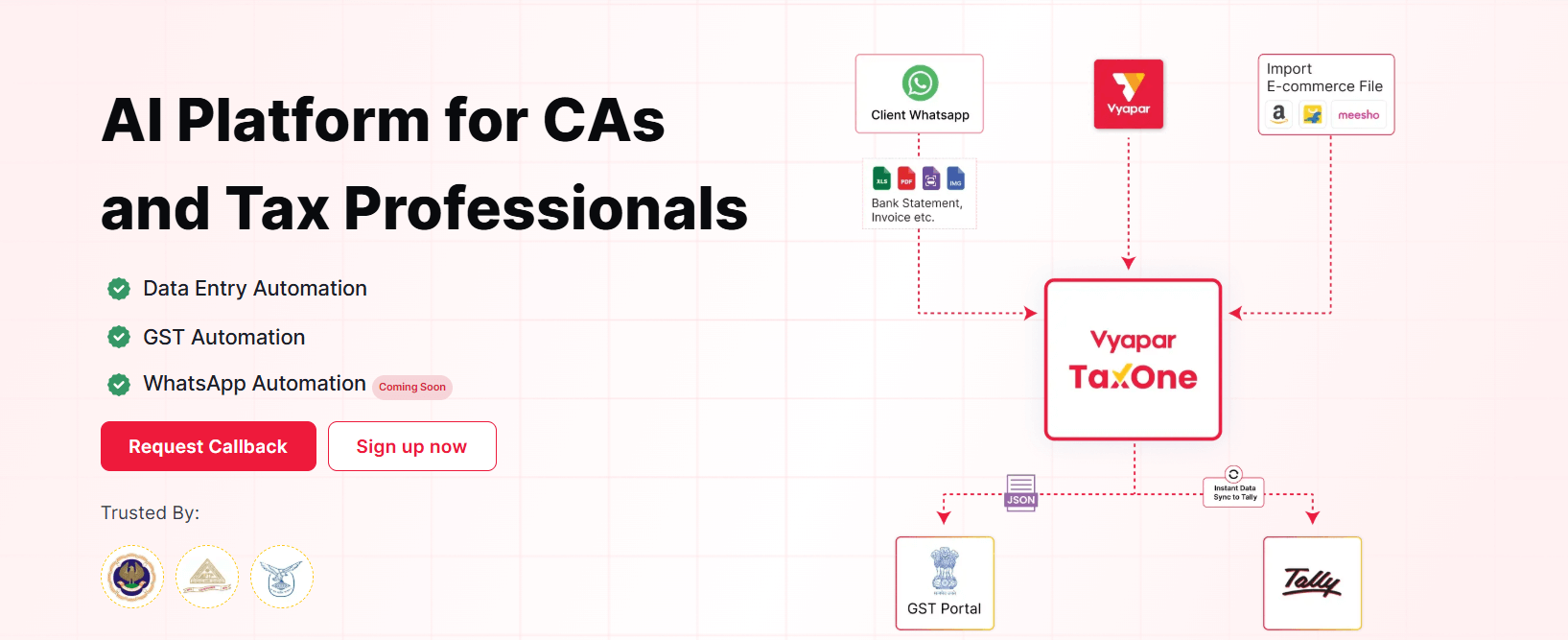
Vyapar Tax One (Suvit) performs well in structured environments with controlled bill volumes.
It works best when invoice formats are consistent and workflows remain predictable.
How It Operates
The system requires you to define processing rules upfront.
For example:
- If vendor name matches X → Map to Y ledger
- If tax rate is 18% → Apply Z treatment
- If invoice format is fixed → Extract predefined fields
Once rules are defined, the system executes them consistently. Think of it as a template based approach to accounts payable automation.
Bulk Upload Capability
Suvit supports bulk upload of up to 10 invoices at a time.
For businesses processing around 50–80 invoices monthly, this is typically manageable. But for firms handling higher volumes, this becomes a bottleneck quickly.
Where It Performs Best
- Businesses with lower to moderate invoice volumes
- Predictable invoice formats from a stable vendor base
- Repetitive GST reconciliation workflows
- Firms that prefer controlled, rule-driven logic
Where It Can Struggle
When business complexity increases:
- Vendors change formats frequently
- Clients operate across industries
- Transaction counts increase significantly
- Exceptions become common
- Volume scales beyond moderate levels
Rule engines require adding or modifying logic continuously. As complexity grows, configuration effort grows in lockstep.
According to ICAI's guidance on technology adoption for CA practices, firms handling multi-industry clients need tools that reduce, not increase, manual configuration overhead as client portfolios expand.
AI Accountant: Features, Accuracy & Ideal Business Type
AI Accountant is built for CA firms and operational businesses handling growing volumes and complexity.
It is suitable for:
- CA firms managing diverse client bases
- Manufacturing companies
- Trading companies
- Distribution businesses
- Service-based companies
Instead of depending fully on predefined rules, it uses pattern recognition and machine learning to automate ledger entry creation, vendor bill matching, and reconciliation.
How It Operates
The system learns from:
- Historical transaction data
- Vendor behavior and invoice patterns
- Ledger mapping patterns
- Bank reconciliation trends
Over time, it improves matching accuracy and reduces manual corrections. It does not require heavy rule configuration at the start.
One thing to expect: AI Accountant's adaptive model needs exposure to your transaction patterns before it hits peak performance. Plan for a 2–4 week learning period during onboarding.
Accuracy builds progressively as the system processes your data, with the support team actively monitoring and fine-tuning during this window.
Bulk Upload & Automation Advantage
AI Accountant supports bulk upload of up to 100 invoices at a time.
This significantly reduces processing time for high volume environments. Think about it: the same 3 minutes that processes 10 bills on one platform processes 100 on the other. That's a 10x throughput difference.
It also enables automatic vendor creation. When a new bill is uploaded, the system can create the vendor automatically based on extracted data. No manual master updates needed.
OCR & Unstructured Invoice Handling
AI Accountant handles structured and multi-format invoices with high accuracy (up to 95% accuracy across varied formats).
This matters when:
- Vendors use different invoice templates
- PDFs are scanned or photographed
- Bills are partially structured
- Line items vary significantly from invoice to invoice
- Handwritten or messy bills are difficult to interpret
Instead of breaking when the format changes, the model adapts. This is especially relevant for Indian businesses where vendor bill formats are rarely standardized, as noted in Economic Times' reporting on SME digital adoption challenges.
Where It Performs Best
- Businesses handling 200+ invoices monthly
- Multi-vendor environments with varied document formats
- Growing CA firms expanding their client portfolios
- Companies planning operational scale
In these environments, manual correction quickly becomes a bottleneck.
Adaptive systems outperform static logic because they get better with more data, not worse.
Real-World Scenarios: What Actually Changes as You Grow?
Scenario 1: 60 Invoices/Month, Fixed Vendors
A business processing around 50–80 invoices monthly with predictable formats. Suvit works well here. Rule-based logic is sufficient, and 10 invoice bulk uploads are manageable.
This is a stable, low complexity environment where the automation tool mostly needs to be reliable, not adaptive.
Scenario 2: 300 Invoices/Month, Multi-Vendor
A trading or manufacturing business onboarding new vendors regularly. Formats vary, ledger mappings shift, and invoice complexity increases.
One AI Accountant client in this situation reduced manual correction time from ~4 hours per week to under 45 minutes within three months. The AI model learned vendor patterns and auto-mapped most invoices without intervention.
A rule-based system in this environment would require ongoing configuration updates every time a new vendor or format appeared.
Scenario 3: Scaling Beyond 1,000 Transactions
At high volume, the architectural difference becomes clear.
Rule-based systems scale by adding more conditions. Every new edge case means a new rule. AI systems scale by learning from more data. Every new transaction makes the model smarter.
For CA firms managing multiple companies on Tally, this is the inflection point where tool choice starts directly affecting team capacity and turnaround time. The Mint has reported that Indian CA firms adopting AI based tools are seeing 30–40% reductions in processing overhead for compliance workflows.
Consolidated Side-by-Side Comparison
| Criteria | Vyapar Tax One (Suvit) | AI Accountant |
|---|---|---|
| Core Architecture | Rule-based engine | AI-based adaptive model |
| Setup Time | Requires rule configuration | Minimal config; 2–4 week learning period |
| Adaptability | Works within defined rules | Learns and improves from usage |
| Handling Format Variations | Needs manual rule updates | Adjusts automatically |
| OCR Strength | Best for structured invoices | Handles multi-format & unstructured |
| Reconciliation Scope | GST-focused + structured logic | GST + Bank + Ledger adaptive matching |
| Scaling Model | Add more rules as complexity grows | Improves with more data |
| Maintenance Load | Continuous rule management | Reduces over time |
| Bulk Upload | 10 at a time | 100 at a time |
| Vendor Creation | Manual | Automatic vendor creation |
| Customer Support | Standard ticketing | Dedicated account managers, WhatsApp + call access |
| Ideal User | Lower-to-moderate volume businesses | CA firms & growing operational companies |
Beyond Invoice Processing: Operational Intelligence & Reporting
Most accounting automation tools stop at extraction and reconciliation.
AI Accountant goes further by transforming raw transaction data into real time financial intelligence.
This is where the difference becomes strategic, not just operational.
Real-Time Dashboards & MIS Reporting
AI Accountant automatically builds real time financial dashboards directly from your Tally data.
No Excel exports.
No manual MIS compilation.
No month end reporting rush.
Instead of waiting for finance teams to prepare reports, management gets instant visibility into:
- Revenue trends and performance tracking
- Expense breakdowns by category
- GST liability and ITC position
- Vendor exposure and outstanding analysis
- Real time cash flow insights
All of this is generated automatically from synced accounting data.
For growing businesses, this eliminates the dependency on manual reporting cycles. Financial insights are always current, always accessible, and always decision ready.
Instead of spending time preparing reports, teams can focus on interpreting them and making better decisions.
Customer Support: A Difference That Matters
Automation tools are only as good as the support behind them, especially during onboarding and when edge cases surface.
AI Accountant provides dedicated onboarding support with assigned account managers. Users get access via WhatsApp and calls, with typical response times under 2 hours during business hours.
The team also proactively reviews automation accuracy during the first month and helps fine-tune configurations. This is particularly valuable during the 2–4 week learning period when the AI model is calibrating to your data.
Vyapar Tax One (Suvit) offers standard support channels suitable for stable, lower volume use cases. However, configuration heavy environments may require more internal effort to resolve setup issues independently.
For growing businesses where misconfiguration or delays cost real money, responsive and hands-on support is not a nice to have. It's a deciding factor.
Which Accounting Automation Tool Is Right for You?
You don't choose software based on features. You choose based on how your business operates.
Choose Vyapar Tax One (Suvit) if:
- You process around 50–80 invoices monthly
- Your formats are consistent
- Bulk uploads remain limited
- Complexity is predictable
Choose AI Accountant if:
- You are a CA firm managing varied clients
- You run a manufacturing, trading, distribution, or service company
- You process 200+ invoices monthly
- You need 100 invoice bulk upload
- You want automation that improves as you grow
- Responsive, hands-on onboarding support matters to you
FAQs
Is AI Accountant accurate from Day 1?
AI Accountant delivers usable accuracy from day one, but reaches peak performance after a 2–4 week learning period. During this window, the system processes your vendor patterns, ledger mappings, and transaction history to calibrate its AI model. Most clients see strong automation performance by the end of the first month, with the support team actively monitoring and fine-tuning accuracy throughout.
Can Suvit handle unstructured invoices?
Suvit works best with structured and consistent invoice formats. Highly varied, multi-format, or handwritten invoices may require additional rule configuration or manual intervention, as its OCR engine is optimized for predictable document layouts.
Does AI Accountant work with Tally?
Yes. AI Accountant integrates natively with Tally Prime for automated voucher creation, ledger posting, and reconciliation. It is purpose built for Tally based workflows.
Which tool is better for CA firms?
AI Accountant is better suited for CA firms managing clients across multiple industries with varied invoice formats and higher volumes. Its adaptive AI model reduces manual configuration as client portfolios grow. Suvit works for CA firms handling stable, lower volume compliance workflows with predictable, consistent formats.
What happens if AI Accountant makes a mistake?
Every transaction is processed with a confidence score. Lower confidence entries are flagged for manual review before final posting, so errors are caught before they hit your books. As the model learns from corrections, the volume of flagged entries decreases over time.
Can I switch from Suvit to AI Accountant?
Yes, migration is straightforward. AI Accountant's onboarding team handles the full setup and transition. Providing historical transaction data during onboarding accelerates the learning period, so the model calibrates faster to your specific vendor and ledger patterns.
How does e-invoicing compliance affect my choice of automation tool?
With India's e-invoicing thresholds expanding in 2025–2026, your tool needs to handle real time IRN validation and auto-population of GST returns (2026 update). AI based systems adapt to regulatory changes without manual reconfiguration, while rule based systems may need frequent updates each time thresholds or formats change.

Rohan Sinha is a fintech and growth leader building aiaccountant.com, focused on simplifying accounting and compliance for Indian businesses through automation. An IIT BHU alumnus, he brings hands-on experience across 0 to 1 product building, growth, and strategy in B2B SaaS and fintech.
.png)